
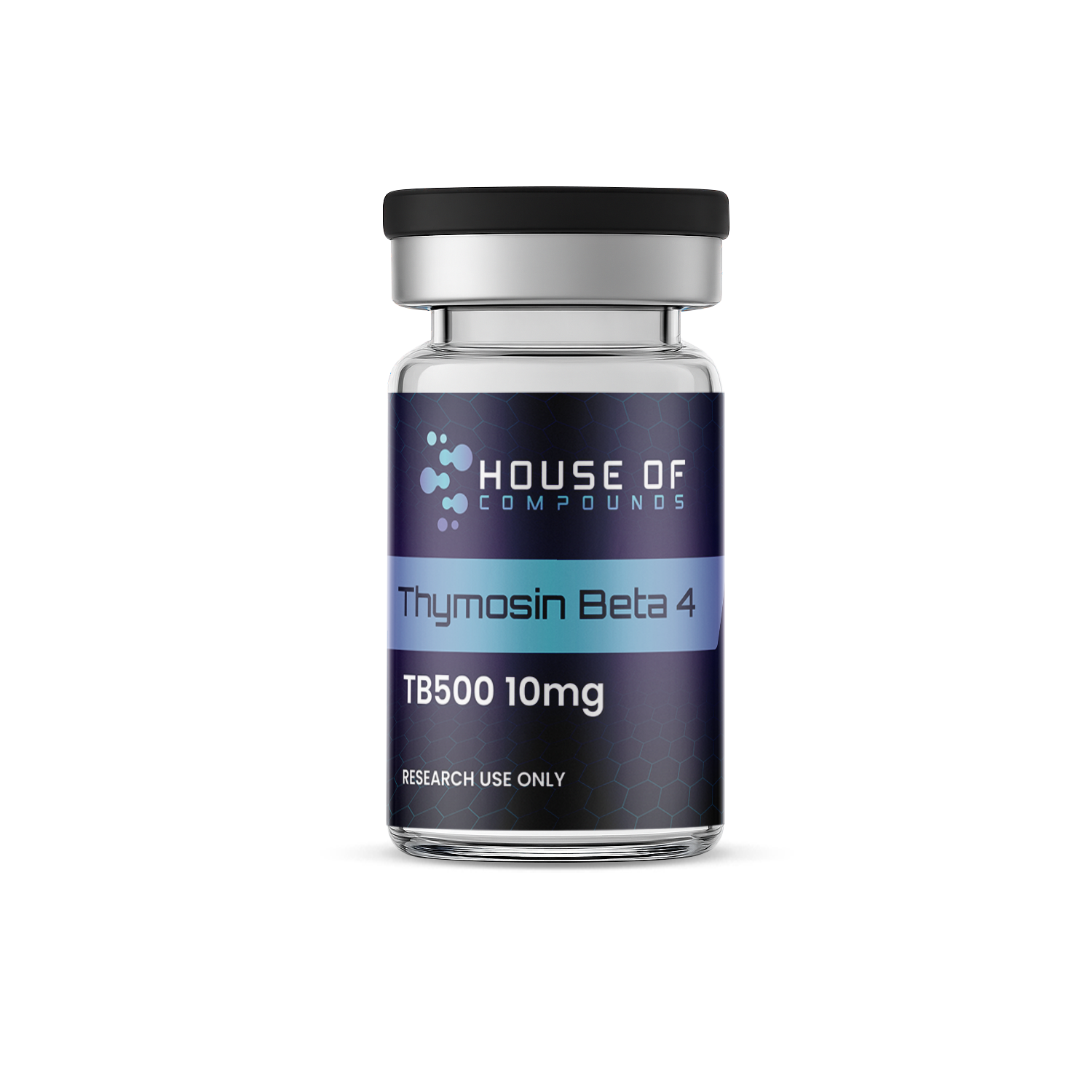
Thymosin Beta 4 (TB500) (10mg)
Original price was: $89.99.$69.99Current price is: $69.99.
2 published certificates
Certificate information is temporarily unavailable.
Description
A single-component research material supplied for controlled research environments. Suitable for studies involving peptide characterization and method development in model systems.Not for human use.
Documentation & Quality Assurance
Each lot is sourced through our verified global supply chain with emphasis on traceability and quality control.These documents are reviewed internally and displayed as they become available. Independent third-party testing is also performed on select lots to confirm identity, purity, and alignment with our internal specifications.
Important Notice
This product is intended for laboratory research use only. It is not intended for human or veterinary use, and must not be used for diagnostic, therapeutic, or clinical purposes.
This material is not a drug, medical device, or dietary supplement, and has not been evaluated by the U.S. Food and Drug Administration.
Quality & Manufacturing
We work directly with the manufacturers. Each supplier is reviewed for reliability, documentation integrity, and transparency in testing.
We require a verified purity of 99% or higher and perform independent third-party spot testing to confirm that select lots meet our internal standards for identity, purity, and composition. Where available, endotoxin testing results are included on Certificates of Analysis to verify laboratory purity; their inclusion is for research quality assessment only and does not imply suitability for human or veterinary use.
All research materials are sealed for integrity and packaged for stability during storage and transport from manufacturing through final delivery.
Additional information
| Weight | 0.0625 lbs |
|---|
Published Scientific Research
Explore the full library of peer-reviewed studies, clinical data, mechanism breakdowns, and molecular specifications for Thymosin Beta 4 (TB500) (10mg).
All research is sourced from PubMed-indexed journals for informational and educational purposes only. For Research Use Only (RUO). Not for human use.
View Full Research Library →Storage Instructions
All products from House of Compounds are manufactured using a lyophilization (freeze-drying) process. This method is designed to maintain product integrity and allows vials to remain stable during shipping for approximately 3–4 months.
Once a vial is reconstituted with bacteriostatic water, it should be stored in the refrigerator to help maintain stability. Under these conditions, reconstituted material is generally considered stable for up to 30 days.
Lyophilization is a dehydration technique in which compounds are frozen and then exposed to low pressure. This causes the water in the vial to sublimate directly from solid to gas, leaving behind a stable, crystalline white structure. This powder can be kept at room temperature until reconstitution.
Upon receipt, products should be stored away from heat and light. For short-term use, refrigeration at approximately 4°C (39°F) is suitable. For long-term storage (several months to years), vials may be placed in a freezer at approximately -80°C (-112°F). Freezing is the preferred method for preserving product stability over extended periods.
⚠️ Important Notice:
These products are intended for research use only. Not for human consumption.
Related products
-
Sale!
GLP-3 RT
Price range: $99.99 through $299.99Select options This product has multiple variants. The options may be chosen on the product page -
Sale!
-
Sale!
DSIP
Price range: $34.99 through $74.99Select options This product has multiple variants. The options may be chosen on the product page
Research Use Only
The following peer-reviewed publications reference compounds for laboratory and in vitro research purposes only. Not for human or animal use. Not intended to diagnose, treat, cure, or prevent any disease or condition.
Published Scientific Research
Peer-reviewed laboratory studies investigating regenerative peptides
Mechanistic study of the Tβ4/SLC7A11 signaling pathway regulating breast cancer evolution.
Thymosin β4 (Tβ4) plays a critical role in breast cancer progression, yet its molecular mechanism remains unclear. Rescue experiments further demonstrated that silencing SLC7A11 abrogates the oncogenic effects of Tβ4 both in vitro and in vivo.
View Full StudyLiving myocardial slices as a model for testing cardiac pro-reparative gene therapies.
Our data show that viral-mediated delivery of these factors induced similar cardiomyocyte gene expression changes in LMS and mouse models.
View Full StudyPlasmacytoid dendritic cells alleviate allergic asthma via airway epithelial cell-dependent thymosin β4 expression.
METHODS: Blood dendritic cell antigen 2-diphtheria toxin receptor (BDCA2-DTR) mice were used for pDC depletion. RNA sequencing of sorted mouse lung pDCs, in vitro cell experiments, and in vivo CCR2 blockade or thymosin β4 (Tβ4) supplementation were performed to elucidate the underlying mechanism.
View Full StudyThymosin β and β Expression in Human Organs during Development: A Review.
This review summarizes the results of a series of studies performed by our group with the aim to define the expression levels of thymosin β and thymosin β over time, starting from fetal development to different ages after birth, in different human organs and tissues. The first section describes the proteomics investigations performed on whole saliva from preterm newborns and gingival crevicular fluid, which revealed to us the importance of these acidic peptides and their multiple functions. Th
View Full StudyTβ4-Ac-SDKP pathway: Any relevance for the cardiovascular system?
The last 20 years witnessed the emergence of the thymosin β4 (Tβ4)--acetyl-seryl-aspartyl-lysyl-proline (Ac-SDKP) pathway as a new source of future therapeutic tools to treat cardiovascular and renal diseases. We also discussed the possible mechanisms involved in the Tβ4-Ac-SDKP-associated cardiovascular biological effects.
View Full StudyThymosin β4 for the treatment of acute stroke: neurorestorative or neuroprotective?
INTRODUCTION: Thymosin β4 (Tβ4) is a 5K peptide which influences cellular migration by inhibiting organization of the actin-cytoskeleton. Treatment of acute stroke presently involves use of rt-PA and/or endovascular treatment with thrombectomy, both of which have time limitations. Therefore, development of a treatment beyond these times is necessary as most stroke patients present beyond these time limits. A drug which could be administered within 24 h from symptom onset would provide substan
View Full Study