
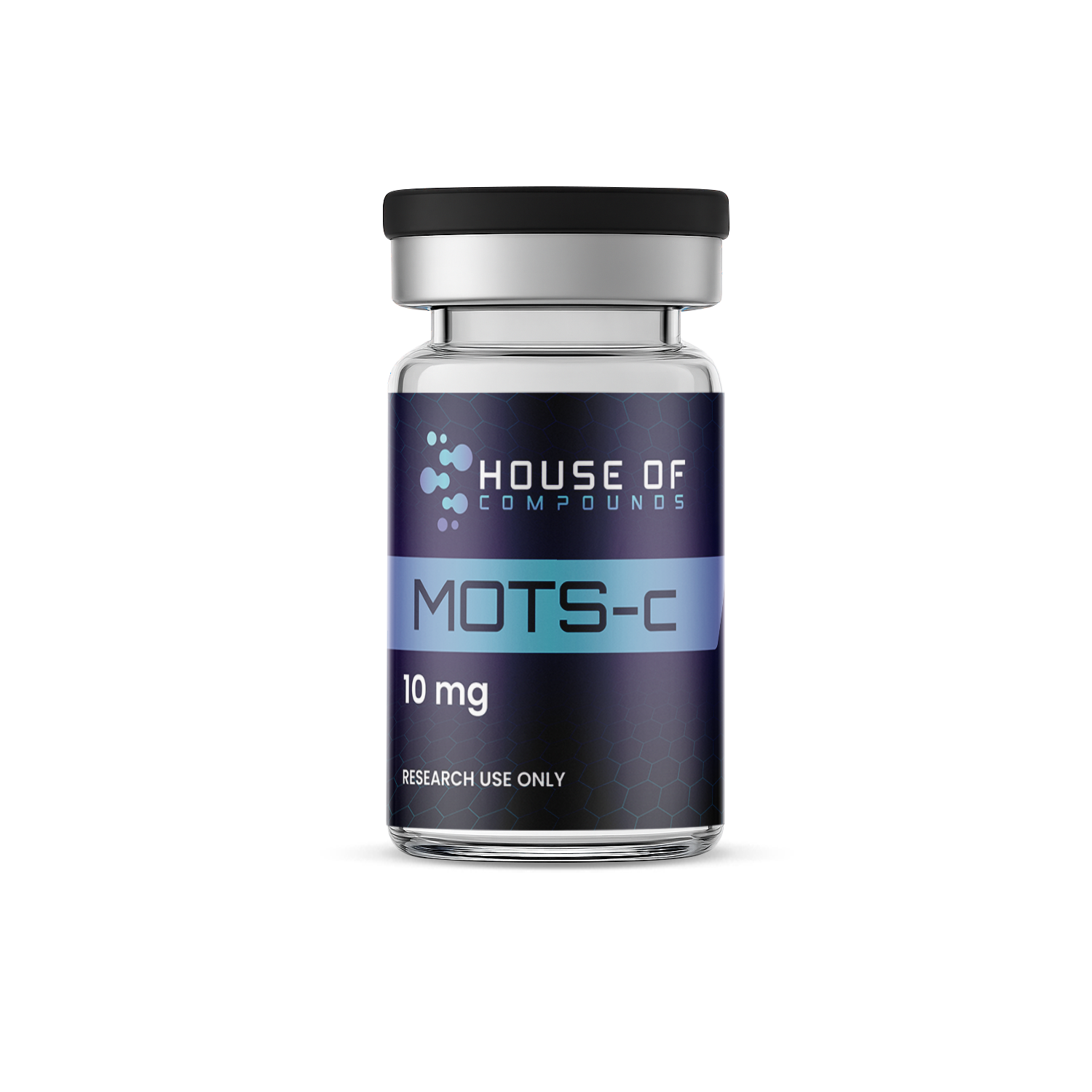
MOTS-c
Price range: $59.99 through $139.99
4 published certificates
Certificate information is temporarily unavailable.
Description
A single-component research material supplied for controlled research environments. Suitable for studies involving mitochondrial-derived peptide characterization and method development in model systems.Not for human use.
Documentation & Quality Assurance
Each lot is sourced through our verified global supply chain with emphasis on traceability and quality control.These documents are reviewed internally and displayed as they become available. Independent third-party testing is also performed on select lots to confirm identity, purity, and alignment with our internal specifications.
Important Notice
This product is intended for laboratory research use only. It is not intended for human or veterinary use, and must not be used for diagnostic, therapeutic, or clinical purposes.
This material is not a drug, medical device, or dietary supplement, and has not been evaluated by the U.S. Food and Drug Administration.
Quality & Manufacturing
We work directly with the manufacturers. Each supplier is reviewed for reliability, documentation integrity, and transparency in testing.
We require a verified purity of 99% or higher and perform independent third-party spot testing to confirm that select lots meet our internal standards for identity, purity, and composition. Where available, endotoxin testing results are included on Certificates of Analysis to verify laboratory purity; their inclusion is for research quality assessment only and does not imply suitability for human or veterinary use.
All research materials are sealed for integrity and packaged for stability during storage and transport from manufacturing through final delivery.
Additional information
| Weight | 0.0625 lbs |
|---|---|
| Dosage | 10mg, 40mg |
Published Scientific Research
Explore the full library of peer-reviewed studies, clinical data, mechanism breakdowns, and molecular specifications for MOTS-c.
All research is sourced from PubMed-indexed journals for informational and educational purposes only. For Research Use Only (RUO). Not for human use.
View Full Research Library →Storage Instructions
All products from House of Compounds are manufactured using a lyophilization (freeze-drying) process. This method is designed to maintain product integrity and allows vials to remain stable during shipping for approximately 3–4 months.
Once a vial is reconstituted with bacteriostatic water, it should be stored in the refrigerator to help maintain stability. Under these conditions, reconstituted material is generally considered stable for up to 30 days.
Lyophilization is a dehydration technique in which compounds are frozen and then exposed to low pressure. This causes the water in the vial to sublimate directly from solid to gas, leaving behind a stable, crystalline white structure. This powder can be kept at room temperature until reconstitution.
Upon receipt, products should be stored away from heat and light. For short-term use, refrigeration at approximately 4°C (39°F) is suitable. For long-term storage (several months to years), vials may be placed in a freezer at approximately -80°C (-112°F). Freezing is the preferred method for preserving product stability over extended periods.
⚠️ Important Notice:
These products are intended for research use only. Not for human consumption.
Related products
-
Sale!
-
Sale!
-
Sale!
Thymosin Beta 4 (TB500) (10mg)
Original price was: $89.99.$69.99Current price is: $69.99.
Research Use Only
The following peer-reviewed publications reference compounds for laboratory and in vitro research purposes only. Not for human or animal use. Not intended to diagnose, treat, cure, or prevent any disease or condition.
Published Scientific Research
Peer-reviewed laboratory studies investigating research peptides
Mitochondrial-derived peptide MOTS-c activates metabolic signaling but blunts reparative function in human mesenchymal stromal cells.
We hypothesized that restoring MOTS-c signaling rescues the impaired functionality of adipose-derived MSCs from individuals with obesity. Nevertheless, although exogenous MOTS-c restored intracellular levels and activated AMPK signaling in obese MSCs, it reduced proliferation, increased expression of senescence-associated genes (p16, p21), and upregulated TNF-α.
View Full StudyMOTS-c in type 2 diabetes mellitus: From risk factors to cardiac complications and potential treatment.
Diabetes mellitus is a major global health issue with complex aetiology and a higher risk of consequent health complications. Advances in research and knowledge prompt new therapies to focus beyond glycemic control to include organ-protective therapies better optimise treatment outcomes. MOTS-c, a recently discovered mitochondria-derived peptide, plays a key role in regulating metabolic homeostasis and stress response. Emerging evidence suggests that insufficient MOTS-c production from dysfuncti
View Full StudyMOTS-c modulates pancreatic islet function in rats and pigs in vitro.
This study assessed the expression and secretion of insulin and glucagon, the expression of their receptors, cell viability, and cell death following MOTS-c treatment of the islets.
View Full StudyMOTS-c Promotes Glycolysis via AMPK-HIF-1α-PFKFB3 Pathway to Ameliorate Cardiopulmonary Bypass-induced Lung Injury.
We investigated the protective effects of mitochondrial open reading frame of the 12S ribosomal RNA type C (MOTS-c), a mitochondrial-derived peptide, against LIRI-induced acute lung injury (ALI), emphasizing glycolytic reprogramming and ferroptosis in pulmonary microvascular endothelial cells. We hypothesized that MOTS-c exerts its protective effects by regulating glycolysis and suppressing ferroptosis via metabolic signaling pathways.
View Full StudyExercise-Induced Muscle-Fat Crosstalk: Molecular Mediators and Their Pharmacological Modulation for the Maintenance of Metabolic Flexibility in Aging.
Regular physical activity induces a dynamic crosstalk between skeletal muscle and adipose tissue, modulating the key molecular pathways that underlie metabolic flexibility, mitochondrial function, and inflammation. Exercise stimulates AMPK, PGC-1α, and SIRT1 signaling, promoting mitochondrial biogenesis, fatty acid oxidation, and autophagy, while also regulating muscle hypertrophy through the PI3K/Akt/mTOR and Wnt/β-catenin pathways.
View Full StudyNovel function of MOTS-c in mitochondrial remodelling contributes to its antiviral role during HBV infection.
This study aims to explore the diagnostic and therapeutic potential of MOTS-c in HBV-related diseases and its molecular mechanism. MOTS-c was found to promote mitochondrial biogenesis and enhance the MAVS (mitochondrial antiviral signalling protein) signalling pathway.
View Full Study