
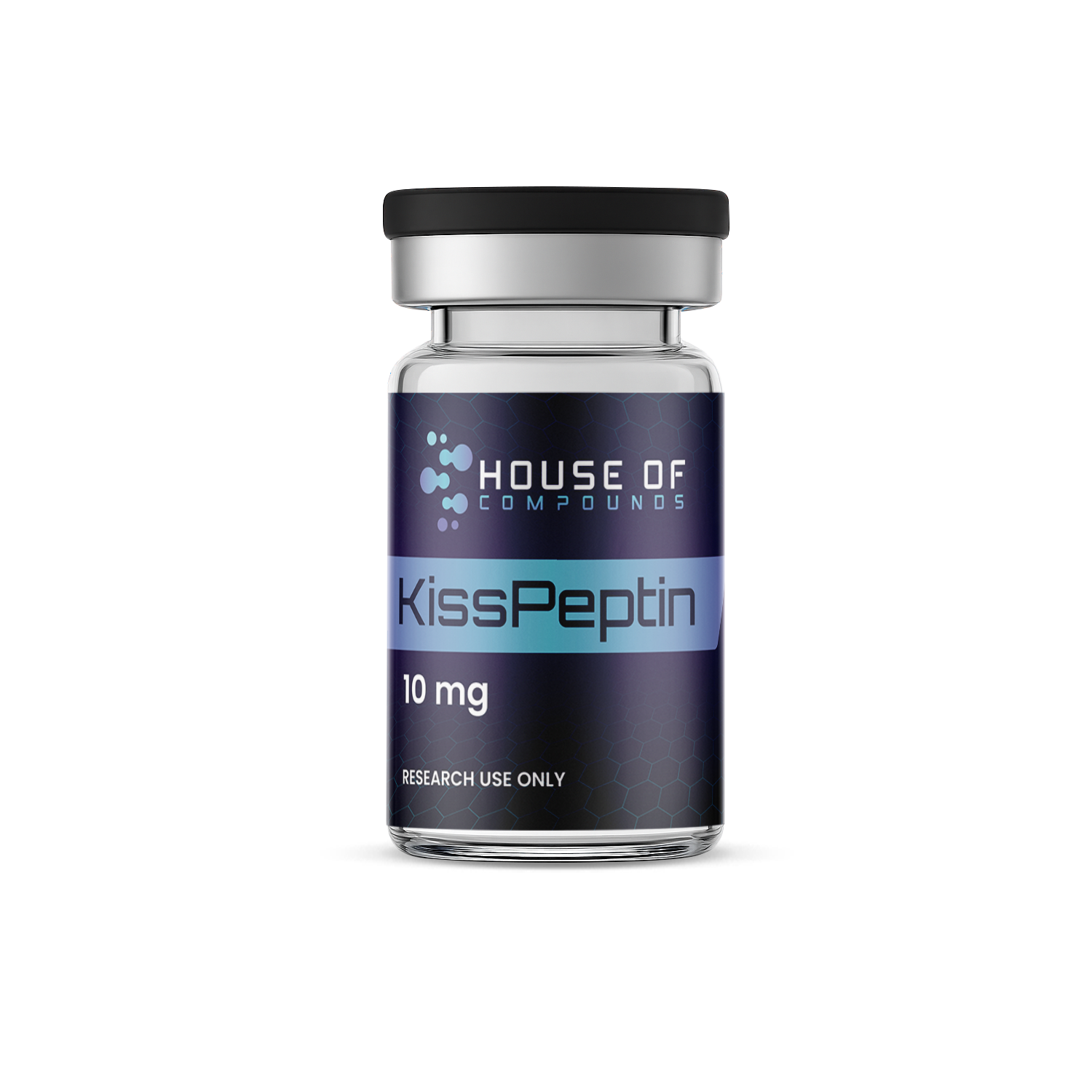
KissPeptin (10mg)
Original price was: $89.99.$69.99Current price is: $69.99.
2 published certificates
Certificate information is temporarily unavailable.
Description
A single-component research material supplied for controlled research environments. KissPeptin-10 (10 mg) is a synthetic decapeptide used in advanced research examining reproductive hormone signaling, hypothalamic-pituitary-gonadal (HPG) axis regulation, and neuroendocrine pathway characterization in model systems.Not for human use.
Documentation & Quality Assurance
Each lot is sourced through our verified global supply chain with emphasis on traceability and quality control.These documents are reviewed internally and displayed as they become available. Independent third-party testing is also performed on select lots to confirm identity, purity, and alignment with our internal specifications.
Important Notice
This product is intended for laboratory research use only. It is not intended for human or veterinary use, and must not be used for diagnostic, therapeutic, or clinical purposes.
This material is not a drug, medical device, or dietary supplement, and has not been evaluated by the U.S. Food and Drug Administration.
Quality & Manufacturing
We work directly with the manufacturers. Each supplier is reviewed for reliability, documentation integrity, and transparency in testing.
We require a verified purity of 99% or higher and perform independent third-party spot testing to confirm that select lots meet our internal standards for identity, purity, and composition. Where available, endotoxin testing results are included on Certificates of Analysis to verify laboratory purity; their inclusion is for research quality assessment only and does not imply suitability for human or veterinary use.
All research materials are sealed for integrity and packaged for stability during storage and transport from manufacturing through final delivery.
Additional information
| Weight | 0.0625 lbs |
|---|
Published Scientific Research
Explore the full library of peer-reviewed studies, clinical data, mechanism breakdowns, and molecular specifications for KissPeptin (10mg).
All research is sourced from PubMed-indexed journals for informational and educational purposes only. For Research Use Only (RUO). Not for human use.
View Full Research Library →Storage Instructions
All products from House of Compounds are manufactured using a lyophilization (freeze-drying) process. This method is designed to maintain product integrity and allows vials to remain stable during shipping for approximately 3–4 months.
Once a vial is reconstituted with bacteriostatic water, it should be stored in the refrigerator to help maintain stability. Under these conditions, reconstituted material is generally considered stable for up to 30 days.
Lyophilization is a dehydration technique in which compounds are frozen and then exposed to low pressure. This causes the water in the vial to sublimate directly from solid to gas, leaving behind a stable, crystalline white structure. This powder can be kept at room temperature until reconstitution.
Upon receipt, products should be stored away from heat and light. For short-term use, refrigeration at approximately 4°C (39°F) is suitable. For long-term storage (several months to years), vials may be placed in a freezer at approximately -80°C (-112°F). Freezing is the preferred method for preserving product stability over extended periods.
⚠️ Important Notice:
These products are intended for research use only. Not for human consumption.
Related products
-
Sale!
GLP-2 TZ
Price range: $89.99 through $249.99Select options This product has multiple variants. The options may be chosen on the product page -
Sale!
SS-31
Price range: $69.99 through $189.99Select options This product has multiple variants. The options may be chosen on the product page -
Sale!
DSIP
Price range: $34.99 through $74.99Select options This product has multiple variants. The options may be chosen on the product page
Research Use Only
The following peer-reviewed publications reference compounds for laboratory and in vitro research purposes only. Not for human or animal use. Not intended to diagnose, treat, cure, or prevent any disease or condition.
Published Scientific Research
Peer-reviewed laboratory studies investigating research peptides
Kisspeptin and neurokinin B: roles in reproductive health.
Over the last two decades, research findings have considerably enhanced our understanding of the physiological regulation of the hypothalamic-pituitary-gonadal (HPG) axis and identified potential therapeutic applications. Moreover, the key role of NKB in the pathophysiology of menopausal hot flashes has led to the development of pharmacological antagonism of this pathway.
View Full StudyMechanism of elevated LH/FSH ratio in lean PCOS revisited: a path analysis.
There was a negative association between dynorphin and kisspeptin, while NKB levels were not associated with kisspeptin. There was no direct association between kisspeptin and the LH/FSH ratio; interestingly, dynorphin was positively associated with the LH/FSH ratio in both bivariate and pathway analyses.
View Full StudyJiawei Buzhong Yiqi Decoction attenuates polycystic ovary syndrome through regulating kisspeptin-GPR54-AKT-SHBG system.
Accumulated evidence has suggested the indispensable role of kisspeptin-G protein-coupled receptor (GPR54) system and SHBG in development of PCOS. However, potential mechanisms and their relationship are unclear.
View Full StudyTargeting KNDy neurons to control GnRH pulses.
Today the 50-year quest for the basic mechanism of GnRH pulse generation may be over, but questions about its physiological tuning remain.
View Full StudyCircadian Rhythms in the Neuronal Network Timing the Luteinizing Hormone Surge.
However, it is becoming increasingly clear that light-induced disruption of circadian rhythms can negatively impact fertility in nonseasonal breeders as well.
View Full StudyThe fifty years following the discovery of gonadotropin-releasing hormone.
This article highlights key milestones in GnRH research that have occurred in the 50 plus years since the discovery of the decapeptide. It is by no means exhaustive and inevitably reflects our limitations and idiosyncratic perspectives.
View Full Study