
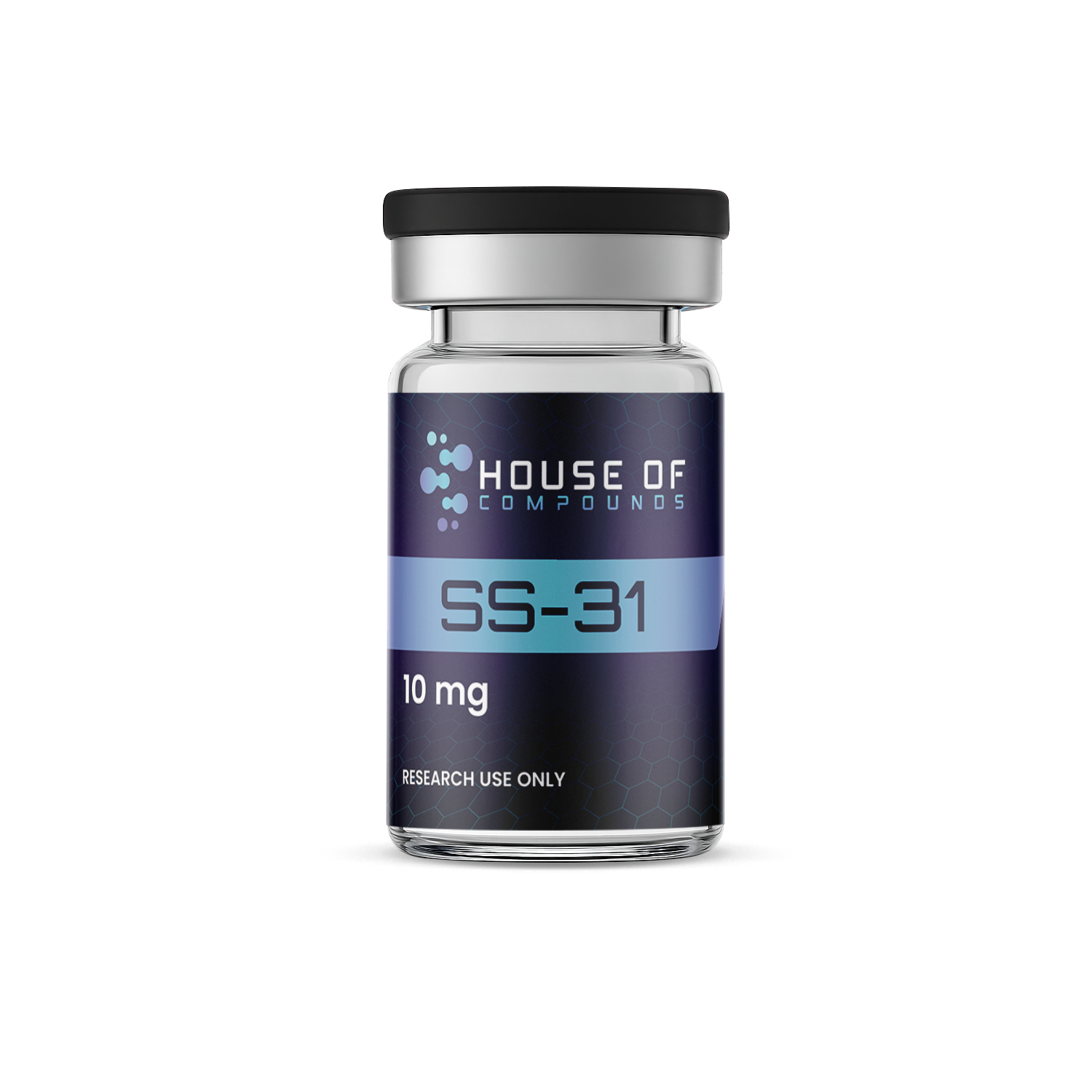
SS-31
Price range: $69.99 through $189.99
2 published certificates
Certificate information is temporarily unavailable.
Description
A single-component research material supplied for controlled research environments. Suitable for studies involving mitochondrial-targeting peptide characterization and method development in model systems.Not for human use.
Documentation & Quality Assurance
Each lot is sourced through our verified global supply chain with emphasis on traceability and quality control.These documents are reviewed internally and displayed as they become available. Independent third-party testing is also performed on select lots to confirm identity, purity, and alignment with our internal specifications.
Important Notice
This product is intended for laboratory research use only. It is not intended for human or veterinary use, and must not be used for diagnostic, therapeutic, or clinical purposes.
This material is not a drug, medical device, or dietary supplement, and has not been evaluated by the U.S. Food and Drug Administration.
Quality & Manufacturing
We work directly with the manufacturers. Each supplier is reviewed for reliability, documentation integrity, and transparency in testing.
We require a verified purity of 99% or higher and perform independent third-party spot testing to confirm that select lots meet our internal standards for identity, purity, and composition. Where available, endotoxin testing results are included on Certificates of Analysis to verify laboratory purity; their inclusion is for research quality assessment only and does not imply suitability for human or veterinary use.
All research materials are sealed for integrity and packaged for stability during storage and transport from manufacturing through final delivery.
Additional information
| Weight | 0.0625 lbs |
|---|---|
| Dosage | 10mg, 50mg |
Published Scientific Research
Explore the full library of peer-reviewed studies, clinical data, mechanism breakdowns, and molecular specifications for SS-31.
All research is sourced from PubMed-indexed journals for informational and educational purposes only. For Research Use Only (RUO). Not for human use.
View Full Research Library →Storage Instructions
All products from House of Compounds are manufactured using a lyophilization (freeze-drying) process. This method is designed to maintain product integrity and allows vials to remain stable during shipping for approximately 3–4 months.
Once a vial is reconstituted with bacteriostatic water, it should be stored in the refrigerator to help maintain stability. Under these conditions, reconstituted material is generally considered stable for up to 30 days.
Lyophilization is a dehydration technique in which compounds are frozen and then exposed to low pressure. This causes the water in the vial to sublimate directly from solid to gas, leaving behind a stable, crystalline white structure. This powder can be kept at room temperature until reconstitution.
Upon receipt, products should be stored away from heat and light. For short-term use, refrigeration at approximately 4°C (39°F) is suitable. For long-term storage (several months to years), vials may be placed in a freezer at approximately -80°C (-112°F). Freezing is the preferred method for preserving product stability over extended periods.
⚠️ Important Notice:
These products are intended for research use only. Not for human consumption.
Related products
-
Sale!
-
Sale!
-
Sale!
DSIP
Price range: $34.99 through $74.99Select options This product has multiple variants. The options may be chosen on the product page
Research Use Only
The following peer-reviewed publications reference compounds for laboratory and in vitro research purposes only. Not for human or animal use. Not intended to diagnose, treat, cure, or prevent any disease or condition.
Published Scientific Research
Peer-reviewed laboratory studies investigating research peptides
SS-31 improves post-cardiac arrest brain injury by inhibiting microglial ferroptosis and polarization.
SS-31, a novel mitochondria-targeting peptide, has demonstrated protective effects against mitochondrial dysfunction induced by ischemia/reperfusion injury. This study aimed to investigate the neuroprotective effects of SS-31 in post-CA brain injury and clarify the underlying signaling mechanisms.
View Full StudyPodocyte senescence: from molecular mechanisms to therapeutics.
Therefore, understanding the aging process of podocytes will allow us to understand their susceptibility to injury and identify targeted protective mechanisms. In addition, CCAAT/enhancer-binding protein-α, transforming growth factor-β signaling, glycogen synthase kinase-3β, cycle-dependent kinase, programmed cell death protein 1, and plasminogen activator inhibitor-1 are closely related to aging.
View Full StudyComprehensive dry eye therapy: overcoming ocular surface barrier and combating inflammation, oxidation, and mitochondrial damage.
Currently, anti-inflammatory drugs have shown promising efficacy in treating DED; however, such drugs are associated with side effects. This calls for investigations to overcome these challenges associated with ocular drug administration.
View Full StudyStructure-activity relationships of mitochondria-targeted tetrapeptide pharmacological compounds.
Notably, analogs had markedly different effects on membrane surface charge, supporting a mechanism in which modulation of membrane electrostatics is a key feature of their mechanism of action. All four peptides were pharmacologically active in serum withdrawal cell stress models yet showed significant differences in their abilities to restore mitochondrial membrane potential, preserve ATP content, and promote cell survival.
View Full StudyElamipretide for Barth syndrome cardiomyopathy: gradual rebuilding of a failed power grid.
Barth syndrome is a rare and potentially fatal X-linked disease characterized by cardiomyopathy, skeletal muscle weakness, growth delays, and cyclic neutropenia. Patients with Barth syndrome are prone to high risk of mortality in infancy and the development of cardiomyopathy with severe weakening of the immune system. Elamipretide is a water-soluble, aromatic-cationic, mitochondria-targeting tetrapeptide that readily penetrates and transiently localizes to the inner mitochondrial membrane. Thera
View Full StudyPodocyte Aging: Why and How Getting Old Matters.
This review discusses the molecular and cellular mechanisms underlying podocyte aging, how these mechanisms might be augmented by disease in the aged kidney, and approaches to mitigate progressive damage to podocytes. Furthermore, we address how biologic pathways such as those associated with cellular growth confound aging in humans and rodents.
View Full Study