
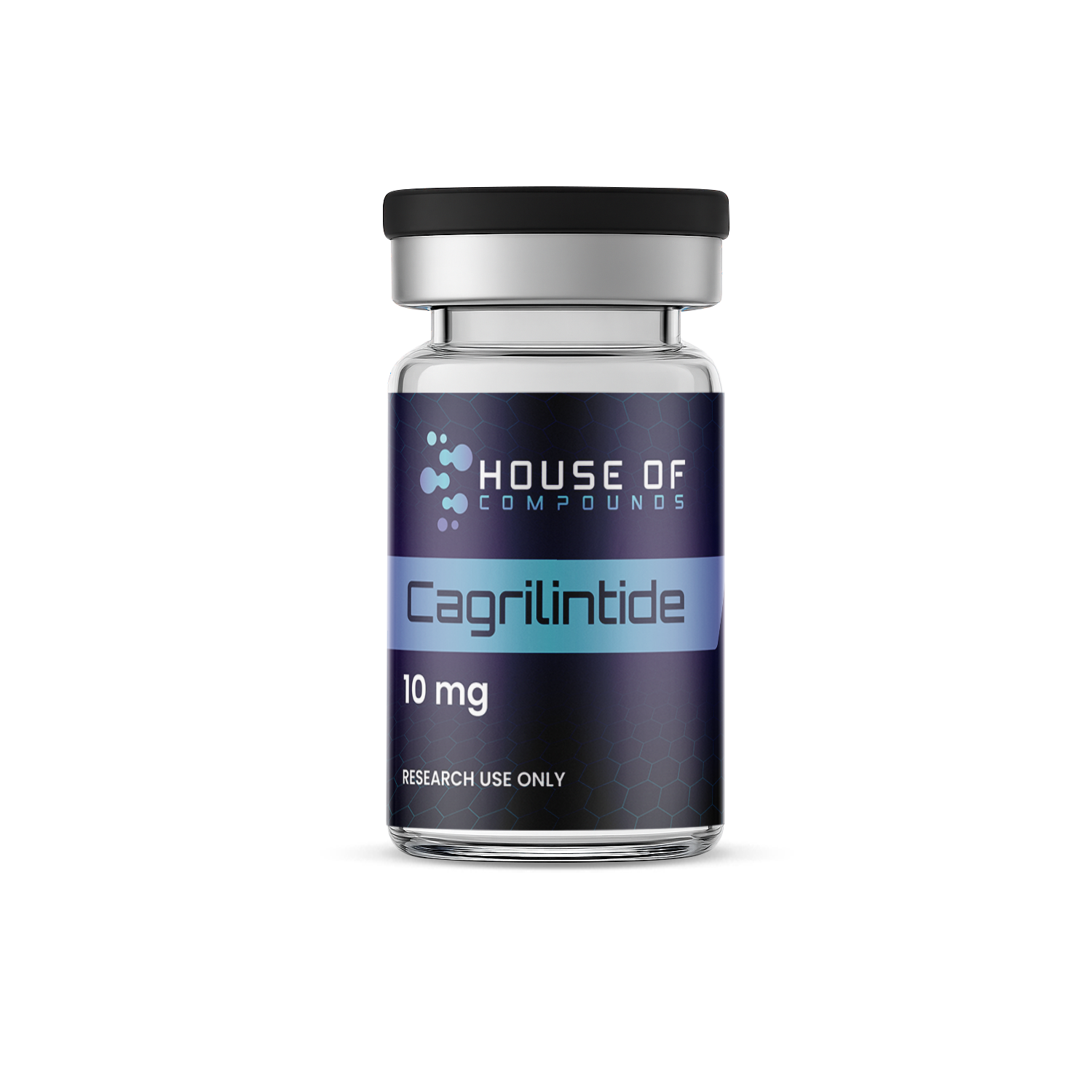
Cagrilintide (10mg)
Original price was: $149.99.$119.99Current price is: $119.99.
1 published certificate
Certificate information is temporarily unavailable.
Description
A single-component research material supplied for controlled research environments. Suitable for studies involving peptide characterization and method development in model systems.Not for human use.
Documentation & Quality Assurance
Each lot is sourced through our verified global supply chain with emphasis on traceability and quality control.These documents are reviewed internally and displayed as they become available. Independent third-party testing is also performed on select lots to confirm identity, purity, and alignment with our internal specifications.
Important Notice
This product is intended for laboratory research use only. It is not intended for human or veterinary use, and must not be used for diagnostic, therapeutic, or clinical purposes.
This material is not a drug, medical device, or dietary supplement, and has not been evaluated by the U.S. Food and Drug Administration.
Quality & Manufacturing
We work directly with the manufacturers. Each supplier is reviewed for reliability, documentation integrity, and transparency in testing.
We require a verified purity of 99% or higher and perform independent third-party spot testing to confirm that select lots meet our internal standards for identity, purity, and composition. Where available, endotoxin testing results are included on Certificates of Analysis to verify laboratory purity; their inclusion is for research quality assessment only and does not imply suitability for human or veterinary use.
All research materials are sealed for integrity and packaged for stability during storage and transport from manufacturing through final delivery.
Additional information
| Weight | 0.0625 lbs |
|---|
Published Scientific Research
Explore the full library of peer-reviewed studies, clinical data, mechanism breakdowns, and molecular specifications for Cagrilintide (10mg).
All research is sourced from PubMed-indexed journals for informational and educational purposes only. For Research Use Only (RUO). Not for human use.
View Full Research Library →Storage Instructions
All products from House of Compounds are manufactured using a lyophilization (freeze-drying) process. This method is designed to maintain product integrity and allows vials to remain stable during shipping for approximately 3–4 months.
Once a vial is reconstituted with bacteriostatic water, it should be stored in the refrigerator to help maintain stability. Under these conditions, reconstituted material is generally considered stable for up to 30 days.
Lyophilization is a dehydration technique in which compounds are frozen and then exposed to low pressure. This causes the water in the vial to sublimate directly from solid to gas, leaving behind a stable, crystalline white structure. This powder can be kept at room temperature until reconstitution.
Upon receipt, products should be stored away from heat and light. For short-term use, refrigeration at approximately 4°C (39°F) is suitable. For long-term storage (several months to years), vials may be placed in a freezer at approximately -80°C (-112°F). Freezing is the preferred method for preserving product stability over extended periods.
⚠️ Important Notice:
These products are intended for research use only. Not for human consumption.
Related products
-
Sale!
Thymosin Beta 4 (TB500) (10mg)
Original price was: $89.99.$69.99Current price is: $69.99. -
Sale!
-
Sale!
GLP-1 S
Price range: $69.99 through $119.99Select options This product has multiple variants. The options may be chosen on the product page
Research Use Only
The following peer-reviewed publications reference compounds for laboratory and in vitro research purposes only. Not for human or animal use. Not intended to diagnose, treat, cure, or prevent any disease or condition.
Published Scientific Research
Peer-reviewed laboratory studies investigating research peptides
Structural and mechanistic insights into dual activation of cagrilintide in amylin and calcitonin receptors.
The global obesity epidemic and its associated metabolic disorders urgently require more effective therapeutic interventions, particularly multi-pathway targeting therapies. Cagrilintide (Cagri), functioning as a dual amylin receptor (AMYRs) and calcitonin receptor (CTR) agonist (DACRA), demonstrates significant efficacy in obesity treatment, although its structural activation mechanism remains unclear.
View Full StudyMitochondrial Adaptations in Skeletal Muscle Following Incretin-Based Therapies: In Vitro.
BACKGROUND: Incretin-based therapies such as glucagon-like peptide-1 receptor agonists (GLP-1Ras), dual GLP-1/GIP agonists and amylin analogues have demonstrated significant weight loss benefits. Tirzepatide promoted sustained improvements in mitochondrial respiration under both healthy and lipotoxic conditions, indicating potential benefits for maintaining skeletal muscle bioenergetic function.
View Full StudyCagrilintide and retatrutide combination therapy enhances weight loss and metabolic outcomes in obese male rats.
Here we demonstrate enhanced metabolic benefits of a combination therapy with retatrutide, a unimolecular GLP-1R/GIPR/GCGR tri-agonist, and cagrilintide, an AMLNR/CALCR co-agonist, in diet-induced obese male rats. Pair-feeding and weight-matching studies reveal that the enhanced weight loss cannot be explained by reduced food intake alone and enable discrimination between weight-loss-dependent and drug-specific molecular responses.
View Full StudyObesity pharmacotherapy reimagined: The era of multi-receptor agonists and next-generation metabolic modulators, perspectives and controversies.
Glucagon-like peptide-1 receptor agonists (GLP-1RAs) have transformed obesity treatment, achieving weight loss previously considered attainable only with bariatric surgery. Existing reviews have focused predominantly on approved GLP-1RAs, with limited synthesis of emerging multi-receptor agonists, oral formulations, and body composition-targeted agents, while guidance on treatment personalization and sequencing strategies remains limited.
View Full StudyCharacterization of 0839 - A tool compound for pre-clinical mode-of-action studies of amylin analogues such as cagrilintide.
Cagrilintide (also known as 0833) is an amylin and calcitonin receptor agonist in clinical development for weight management and type-2-diabetes in a fixed-dose combination with semaglutide. Here, we introduce 0174-0839 (0839) as a tool compound for mouse and rat in vivo and in vitro studies of amylin analogues such as cagrilintide. Structurally, 0839 shares 95 % sequence homology with 0833 and contains an identical acylation sidechain. Acute administration of 0839 and 0833 to normal weight rat
View Full StudyCreating the amylin story.
This paper is based on a presentation given at the Annual Meeting of the Society for the Study of Ingestive Behavior in July 2021 and provides a personal view on some of the milestones in the discovery of amylin as a constituent of pancreatic islet amyloid deposits, as a pancreatic beta-cell hormone, and on its role in physiology and pathophysiology. Only selected effects of amylin are discussed here because we recently published extensive reviews on the physiology and pathophysiology of amylin.
View Full Study