
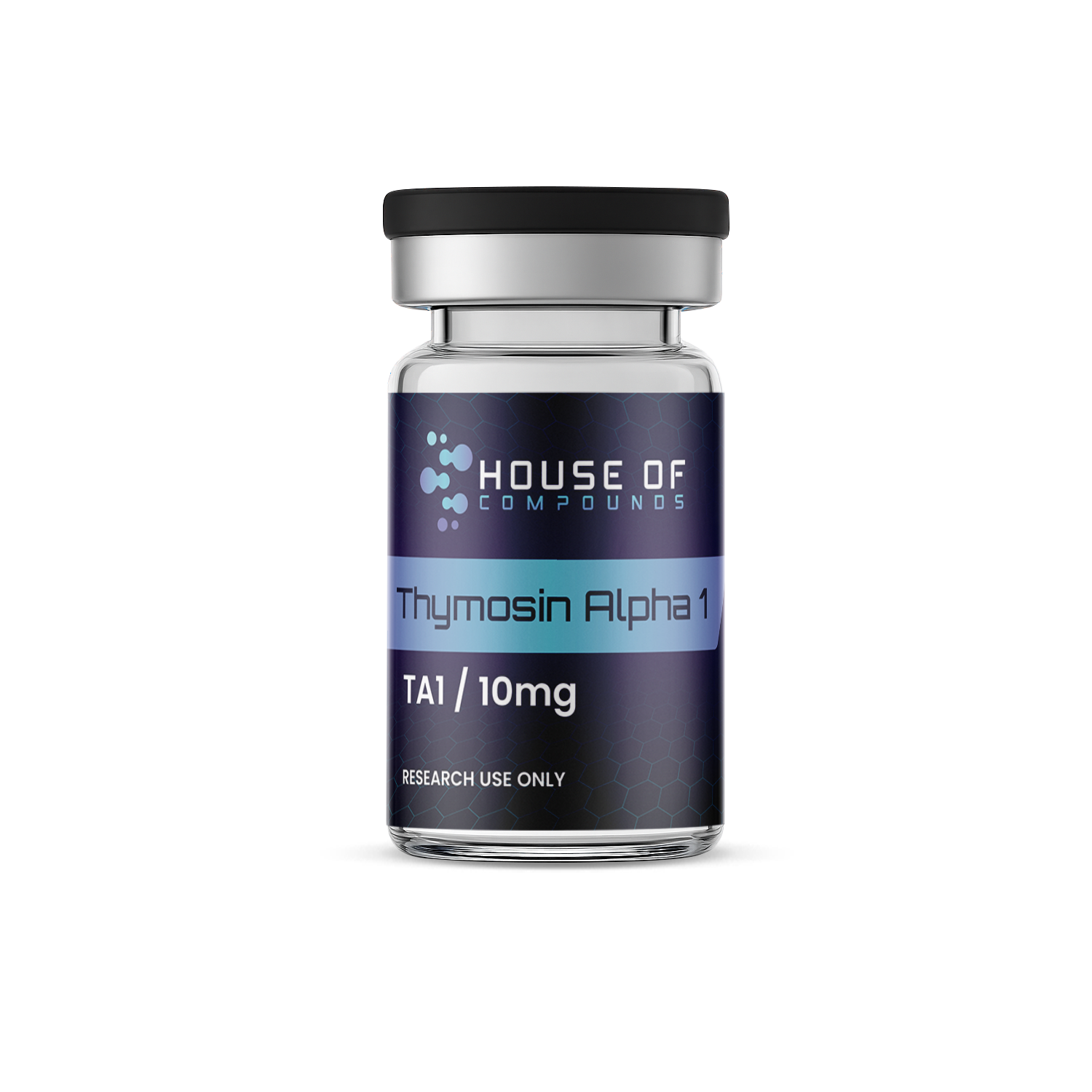
Thymosin Alpha 1 (TA1) (10mg)
Original price was: $99.99.$79.99Current price is: $79.99.
2 published certificates
Certificate information is temporarily unavailable.
Description
A single-component research material supplied for controlled research environments. Suitable for studies involving peptide characterization and method development in model systems.Not for human use.
Documentation & Quality Assurance
Each lot is sourced through our verified global supply chain with emphasis on traceability and quality control.These documents are reviewed internally and displayed as they become available.
Important Notice
This product is intended for laboratory research use only. It is not intended for human or veterinary use, and must not be used for diagnostic, therapeutic, or clinical purposes.
This material is not a drug, medical device, or dietary supplement, and has not been evaluated by the U.S. Food and Drug Administration.
Quality & Manufacturing
We work directly with the manufacturers. Each supplier is reviewed for reliability, documentation integrity, and transparency in testing.
Our minimum purity standard is 98%. Every batch we ship has its own certificate of analysis, and every certificate confirms identity, purity and net content. Where available, endotoxin testing results are included on Certificates of Analysis to verify laboratory purity; their inclusion is for research quality assessment only and does not imply suitability for human or veterinary use.
All research materials are sealed for integrity and packaged for stability during storage and transport from manufacturing through final delivery.
Additional information
| Weight | 0.0625 lbs |
|---|
Published Scientific Research
Explore the full library of peer-reviewed studies, clinical data, mechanism breakdowns, and molecular specifications for Thymosin Alpha 1 (TA1) (10mg).
All research is sourced from PubMed-indexed journals for informational and educational purposes only. For Research Use Only (RUO). Not for human use.
View Full Research Library →Storage Instructions
All products from House of Compounds are manufactured using a lyophilization (freeze-drying) process. This method is designed to maintain product integrity and allows vials to remain stable during shipping for approximately 3–4 months.
Once a vial is reconstituted with bacteriostatic water, it should be stored in the refrigerator to help maintain stability. Under these conditions, reconstituted material is generally considered stable for up to 30 days.
Lyophilization is a dehydration technique in which compounds are frozen and then exposed to low pressure. This causes the water in the vial to sublimate directly from solid to gas, leaving behind a stable, crystalline white structure. This powder can be kept at room temperature until reconstitution.
Upon receipt, products should be stored away from heat and light. For short-term use, refrigeration at approximately 4°C (39°F) is suitable. For long-term storage (several months to years), vials may be placed in a freezer at approximately -80°C (-112°F). Freezing is the preferred method for preserving product stability over extended periods.
⚠️ Important Notice:
These products are intended for research use only. Not for human consumption.
Related products
-
Sale!
Wolverine Blend – BPC-157 (5mg) / TB500 (5mg)
Price range: $84.99 through $129.99Select options This product has multiple variants. The options may be chosen on the product page -
Sale!
-
Sale!
GLP-1 S
Price range: $69.99 through $119.99Select options This product has multiple variants. The options may be chosen on the product page
Research Use Only
The following peer-reviewed publications reference compounds for laboratory and in vitro research purposes only. Not for human or animal use. Not intended to diagnose, treat, cure, or prevent any disease or condition.
Published Scientific Research
Peer-reviewed laboratory studies investigating regenerative peptides
Aging and Thymosin Alpha-1.
Aging is characterized by immune decline, mainly due to thymic involution-the age-related shrinkage of the thymus gland. This leads to reduced T-cell production, chronic inflammation, and increased susceptibility to age-related diseases. Thymosin alpha-1 (Tα1), a peptide hormone produced by the thymus, exhibits potent immunomodulatory, anti-inflammatory, and antioxidant properties. It helps restore immune function by stimulating T-cell differentiation, enhancing thymic output, and modulating de
View Full StudyPhenotypic drug discovery: a case for thymosin alpha-1.
Ultimately, disease definitions are mostly symptom-based rather than mechanism-based, and the therapeutics should be likewise.
View Full StudyMechanism and clinical application of thymosin in the treatment of lung cancer.
The effectiveness of thymosin drugs in the treatment of lung cancer has been demonstrated in numerous studies, which amply demonstrates the potential and future of thymosin drugs for the treatment of lung cancer.
View Full StudyIdentification and determination of structurally related peptide impurities in thymalfasin by liquid chromatography-high-resolution mass spectrometry.
Thymalfasin is an important peptide drug widely used for the single or combination treatment of hepatitis, sepsis, cancer, and immunodeficiency. Accurate purity assessment of thymalfasin material is essential for thymalfasin certified reference materials (CRMs) production and analytical method validation, in which comprehensive determination of thymalfasin-related impurities is required to avoid quantitative bias. In this study, liquid chromatography-high-resolution mass spectrometry (LC-hrMS) m
View Full StudyDNA Dendrons as Agents for Intracellular Delivery.
This effect is due to the interaction of the DNA dendrons with scavenger receptor-A on cell surfaces, which results in their rapid endocytosis.
View Full StudyThymosin α1 protects from CTLA-4 intestinal immunopathology.
Indeed, although beneficial at the tumor site, unlocking a safeguard mechanism of the immune response may trigger autoimmune-like effects at the periphery, thus making the safety of immune checkpoint inhibitors a research priority. Herein, we demonstrate that thymosin α1 (Tα1), an endogenous peptide with immunomodulatory activities, can protect mice from intestinal toxicity in a murine model of immune checkpoint inhibitor-induced colitis.
View Full Study