
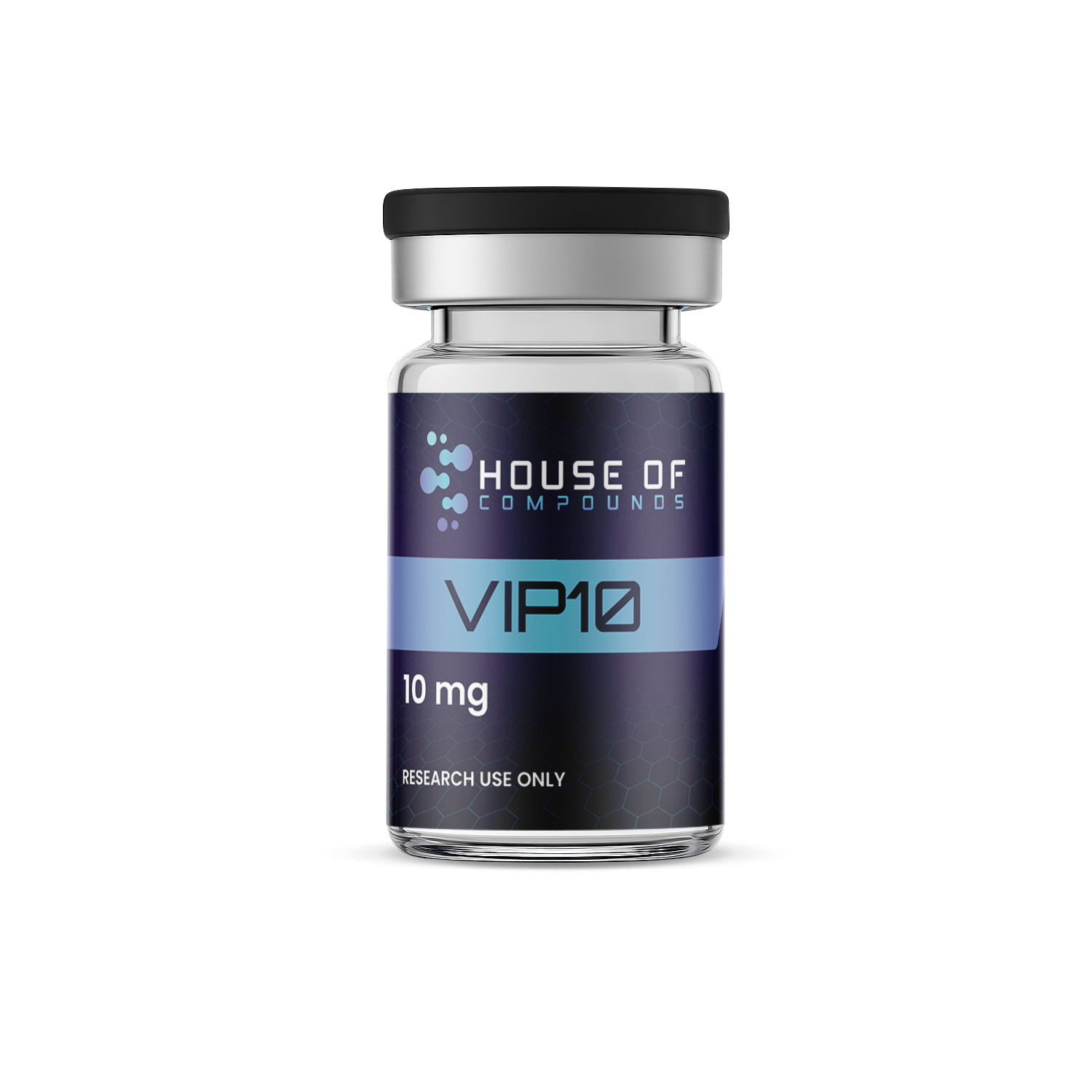
VIP10 (10mg)
Original price was: $99.99.$79.99Current price is: $79.99.
1 published certificate
Certificate information is temporarily unavailable.
Description
A single-component research material supplied for controlled research environments. VIP10 (Vasoactive Intestinal Peptide, 10 mg) is a synthetic neuropeptide used in research focused on smooth muscle relaxation, circadian rhythm regulation, and immune signaling pathways in controlled model systems.
Composition
• VIP10 (Vasoactive Intestinal Peptide)
• Appearance: Lyophilized powder in a sealed research vial
Research Focus (non-clinical)
• Characterization of VIP’s effects on vasodilation and smooth muscle cell models
• Studies on immune modulation and cytokine signaling pathways
• Research exploring VIP’s role in circadian rhythm regulation and gastrointestinal physiology
• Stability and solubility profiling under laboratory storage conditions
For qualified research professionals and institutional laboratories. Not for human use.
Documentation & Quality Assurance
Each lot is sourced through our verified global supply chain with emphasis on traceability and quality control.These documents are reviewed internally and displayed as they become available. Independent third-party testing is also performed on select lots to confirm identity, purity, and alignment with our internal specifications.
Important Notice
This product is intended for laboratory research use only. It is not intended for human or veterinary use, and must not be used for diagnostic, therapeutic, or clinical purposes.
This material is not a drug, medical device, or dietary supplement, and has not been evaluated by the U.S. Food and Drug Administration.
Quality & Manufacturing
We work directly with the manufacturers. Each supplier is reviewed for reliability, documentation integrity, and transparency in testing.
We require a verified purity of 99% or higher and perform independent third-party spot testing to confirm that select lots meet our internal standards for identity, purity, and composition. Where available, endotoxin testing results are included on Certificates of Analysis to verify laboratory purity; their inclusion is for research quality assessment only and does not imply suitability for human or veterinary use.
All research materials are sealed for integrity and packaged for stability during storage and transport from manufacturing through final delivery.
Additional information
| Weight | 0.0625 lbs |
|---|
Published Scientific Research
Explore the full library of peer-reviewed studies, clinical data, mechanism breakdowns, and molecular specifications for VIP10 (10mg).
All research is sourced from PubMed-indexed journals for informational and educational purposes only. For Research Use Only (RUO). Not for human use.
View Full Research Library →Storage Instructions
All products from House of Compounds are manufactured using a lyophilization (freeze-drying) process. This method is designed to maintain product integrity and allows vials to remain stable during shipping for approximately 3–4 months.
Once a vial is reconstituted with bacteriostatic water, it should be stored in the refrigerator to help maintain stability. Under these conditions, reconstituted material is generally considered stable for up to 30 days.
Lyophilization is a dehydration technique in which compounds are frozen and then exposed to low pressure. This causes the water in the vial to sublimate directly from solid to gas, leaving behind a stable, crystalline white structure. This powder can be kept at room temperature until reconstitution.
Upon receipt, products should be stored away from heat and light. For short-term use, refrigeration at approximately 4°C (39°F) is suitable. For long-term storage (several months to years), vials may be placed in a freezer at approximately -80°C (-112°F). Freezing is the preferred method for preserving product stability over extended periods.
⚠️ Important Notice:
These products are intended for research use only. Not for human consumption.
Related products
-
Sale!
SS-31
Price range: $69.99 through $189.99Select options This product has multiple variants. The options may be chosen on the product page -
Sale!
GLP-1 S
Price range: $69.99 through $119.99Select options This product has multiple variants. The options may be chosen on the product page -
Sale!
Research Use Only
The following peer-reviewed publications reference compounds for laboratory and in vitro research purposes only. Not for human or animal use. Not intended to diagnose, treat, cure, or prevent any disease or condition.
Published Scientific Research
Peer-reviewed laboratory studies investigating research peptides
Tat-NTS peptide protects neurons against cerebral ischemia-reperfusion injury via ANXA1 SUMOylation in microglia.
Many studies have emphasized a well-established function of Annexin-A1 (ANXA1) in the immune system, including the regulation of microglial activation. We discovered the underlying mechanism that Tat-NTS peptide targets microglial ANXA1 to protect against ischemic brain injury.
View Full StudyMechanisms Inspired Targeting Peptides.
Peptides targeting ligands or receptors in CIP have been designed based on three-dimensional structures of target proteins or directly selected by random peptide libraries in biological display systems.
View Full StudyMechanisms and consequences of Jak-STAT signaling in the immune system.
Kinases of the Jak ('Janus kinase') family and transcription factors (TFs) of the STAT ('signal transducer and activator of transcription') family constitute a rapid membrane-to-nucleus signaling module that affects every aspect of the mammalian immune system.
View Full StudyLeptin Dysfunction and Alzheimer's Disease: Evidence from Cellular, Animal, and Human Studies.
There is accumulating evidence from epidemiological studies that changes in body weight are associated with Alzheimer's disease (AD) from mid-life obesity increasing the risk of developing AD to weight loss occurring at the earliest stages of AD. Not only can alterations in leptin levels and function worsen cognitive decline and progression of AD pathology, but AD pathology, in of itself, can disrupt leptin signaling, which together would lead to a downward spiral of progressive neurodegeneration and worsening body weight and systemic metabolic deficits.
View Full StudyDrug resistance-related microRNAs in hematological malignancies: translating basic evidence into therapeutic strategies.
Extensive investigations have discovered diverse mechanisms underlying MDR. More recently, increasing evidence demonstrates that miRNAs play a key regulatory role in MDR in hematological malignancies through modulating drug transporter-related proteins, cell cycle-related proteins, drug targets, autophagy, tumor microenvironment, cell survival signaling and apoptosis pathways.
View Full StudyMolecular pathways: IL11 as a tumor-promoting cytokine-translational implications for cancers.
Among these cytokines, the GP130 family, which encompasses, among others, IL6 and IL11, plays a major role in orchestrating these complex processes through the activation of the latent signal transducer and activator of transcription 3 (STAT3) in the epithelium. However, many of the molecular mechanisms that govern and ensure effective epithelial wound healing and regeneration renewal also promote tumorigenesis and the progression of established cancers.
View Full Study