
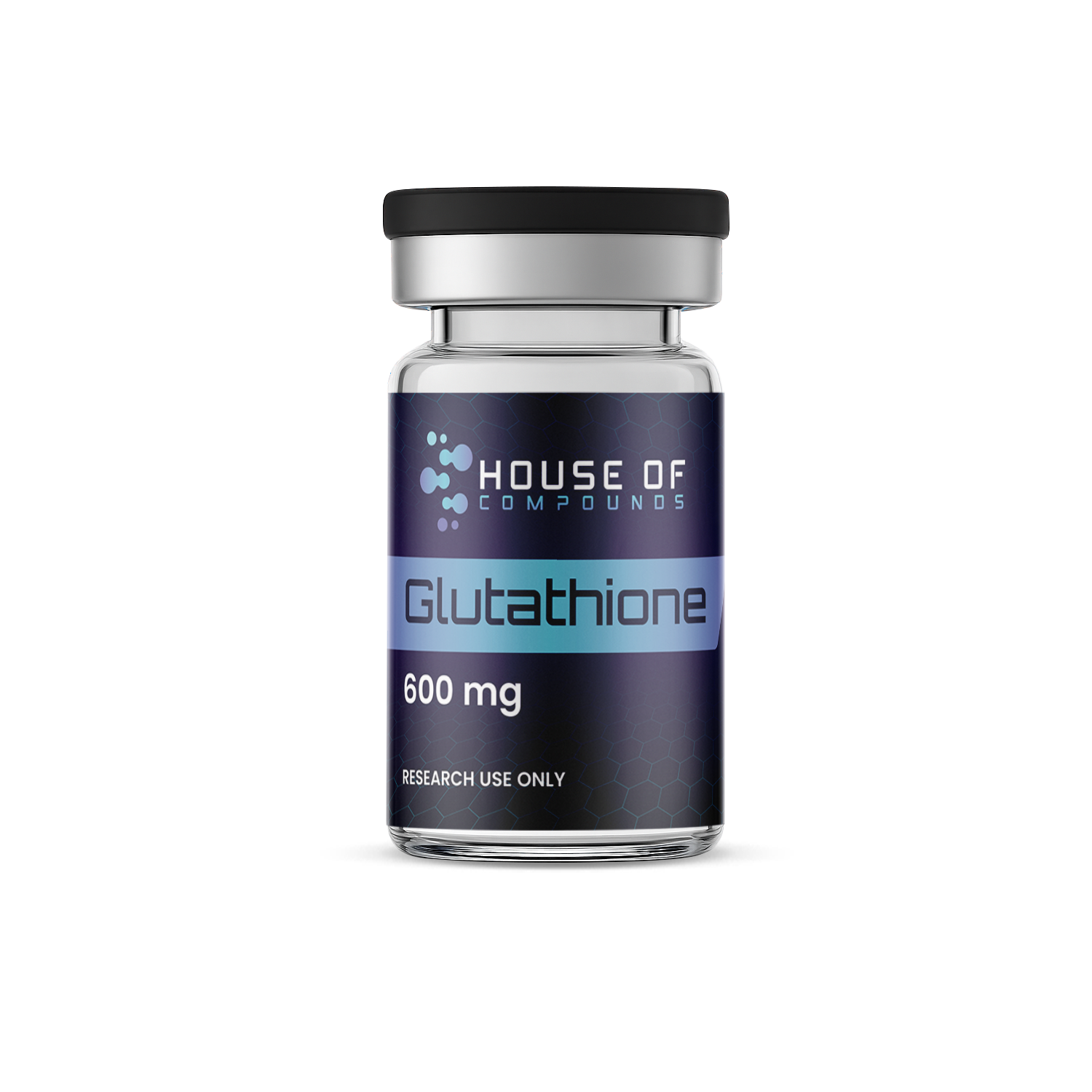
Glutathione
Price range: $54.99 through $79.99
1 published certificate
Certificate information is temporarily unavailable.
Description
A single-component research material supplied for controlled research environments. Glutathione (600 mg) is a tripeptide (γ-L-glutamyl-L-cysteinylglycine) widely studied for its role in redox regulation, detoxification pathways, and cellular defense mechanisms. This preparation is intended for research use in biochemical and pharmacological model systems.Not for human use.
Documentation & Quality Assurance
Each lot is sourced through our verified global supply chain with emphasis on traceability and quality control.These documents are reviewed internally and displayed as they become available. Independent third-party testing is also performed on select lots to confirm identity, purity, and alignment with our internal specifications.
Important Notice
This product is intended for laboratory research use only. It is not intended for human or veterinary use, and must not be used for diagnostic, therapeutic, or clinical purposes.
This material is not a drug, medical device, or dietary supplement, and has not been evaluated by the U.S. Food and Drug Administration.
Quality & Manufacturing
We work directly with the manufacturers. Each supplier is reviewed for reliability, documentation integrity, and transparency in testing.
We require a verified purity of 99% or higher and perform independent third-party spot testing to confirm that select lots meet our internal standards for identity, purity, and composition. Where available, endotoxin testing results are included on Certificates of Analysis to verify laboratory purity; their inclusion is for research quality assessment only and does not imply suitability for human or veterinary use.
All research materials are sealed for integrity and packaged for stability during storage and transport from manufacturing through final delivery.
Additional information
| Weight | 0.0625 lbs |
|---|---|
| Dosage | 600mg, 1500mg |
Published Scientific Research
Explore the full library of peer-reviewed studies, clinical data, mechanism breakdowns, and molecular specifications for Glutathione.
All research is sourced from PubMed-indexed journals for informational and educational purposes only. For Research Use Only (RUO). Not for human use.
View Full Research Library →Storage Instructions
All products from House of Compounds are manufactured using a lyophilization (freeze-drying) process. This method is designed to maintain product integrity and allows vials to remain stable during shipping for approximately 3–4 months.
Once a vial is reconstituted with bacteriostatic water, it should be stored in the refrigerator to help maintain stability. Under these conditions, reconstituted material is generally considered stable for up to 30 days.
Lyophilization is a dehydration technique in which compounds are frozen and then exposed to low pressure. This causes the water in the vial to sublimate directly from solid to gas, leaving behind a stable, crystalline white structure. This powder can be kept at room temperature until reconstitution.
Upon receipt, products should be stored away from heat and light. For short-term use, refrigeration at approximately 4°C (39°F) is suitable. For long-term storage (several months to years), vials may be placed in a freezer at approximately -80°C (-112°F). Freezing is the preferred method for preserving product stability over extended periods.
⚠️ Important Notice:
These products are intended for research use only. Not for human consumption.
Related products
Research Use Only
The following peer-reviewed publications reference compounds for laboratory and in vitro research purposes only. Not for human or animal use. Not intended to diagnose, treat, cure, or prevent any disease or condition.
Published Scientific Research
Peer-reviewed laboratory studies investigating research peptides
Glutathione-depleting Liposome Adjuvant for Augmenting the Efficacy of a Glutathione Covalent Inhibitor Oridonin for Acute Myeloid Leukemia Therapy.
METHODS: We initially elucidated the chemical mechanism underpinning oridonin, a diminutive pharmacological agent demonstrated to perturb reactive oxygen species, through its covalent interaction with glutathione. In a pursuit to further refine the targeting for acute myeloid leukemia (AML), we harnessed the maleic imide and thiol reaction mechanism, facilitating the coupling of Toll-like receptor 2 (TLR2) peptides to the liposomes' surface via maleic imide.
View Full StudyPathological environment directed in situ peptidic supramolecular assemblies for nanomedicines.
These assemblies have exhibited great inhibition efficacy, as well as enhanced imaging contrast, against cancer models both in vitro and in vivo. A number of different molecular designs have demonstrated the potential antibacterial application with satisfied efficiency for peptidic supramolecular assemblies.
View Full StudyStructure-Based Reactivity Profiles of Reactive Metabolites with Glutathione.
Therapeutic agents can be transformed into reactive metabolites under the action of various metabolic enzymes and then covalently combine with biological macromolecules (such as protein or DNA), resulting in increasing toxicity. The screening of reactive metabolites in drug discovery and development stages and monitoring of biotransformation in post-market drugs has become an important research field. Generally, reactive metabolites are electrophilic and can be captured by small nucleophiles. G
View Full StudyGlutathione: subcellular distribution and membrane transport .
Whilst glutathione transport is essential for the supply and replenishment of subcellular glutathione pools, recent evidence supports a more active role for glutathione transport in the regulation of subcellular glutathione redox homeostasis. In particular, we discuss the known and putative glutathione transporters and examine their contribution to the regulation of subcellular glutathione redox homeostasis.
View Full StudyPreparation of Tetradentate Copper Chelators as Potential Anti-Alzheimer Agents.
Full characterization of these ligands is reported, as well as their affinities for Cu , and their capacities to inhibit oxidative stress induced by copper-amyloids activated by a reductant.
View Full StudyMethods Employed in Cytofluorometric Assessment of Eryptosis, the Suicidal Erythrocyte Death.
Signalling involved in the regulation of eryptosis includes Ca2+ entry, ceramide, caspases, calpain, p38 kinase, protein kinase C, Janus-activated kinase 3, casein kinase 1α, cyclin-dependent kinase 4, AMP-activated kinase, p21-activated kinase 2, cGMP-dependent protein kinase, mitogen- and stress-activated kinase MSK1/2, and ill-defined tyrosine kinases.
View Full Study