
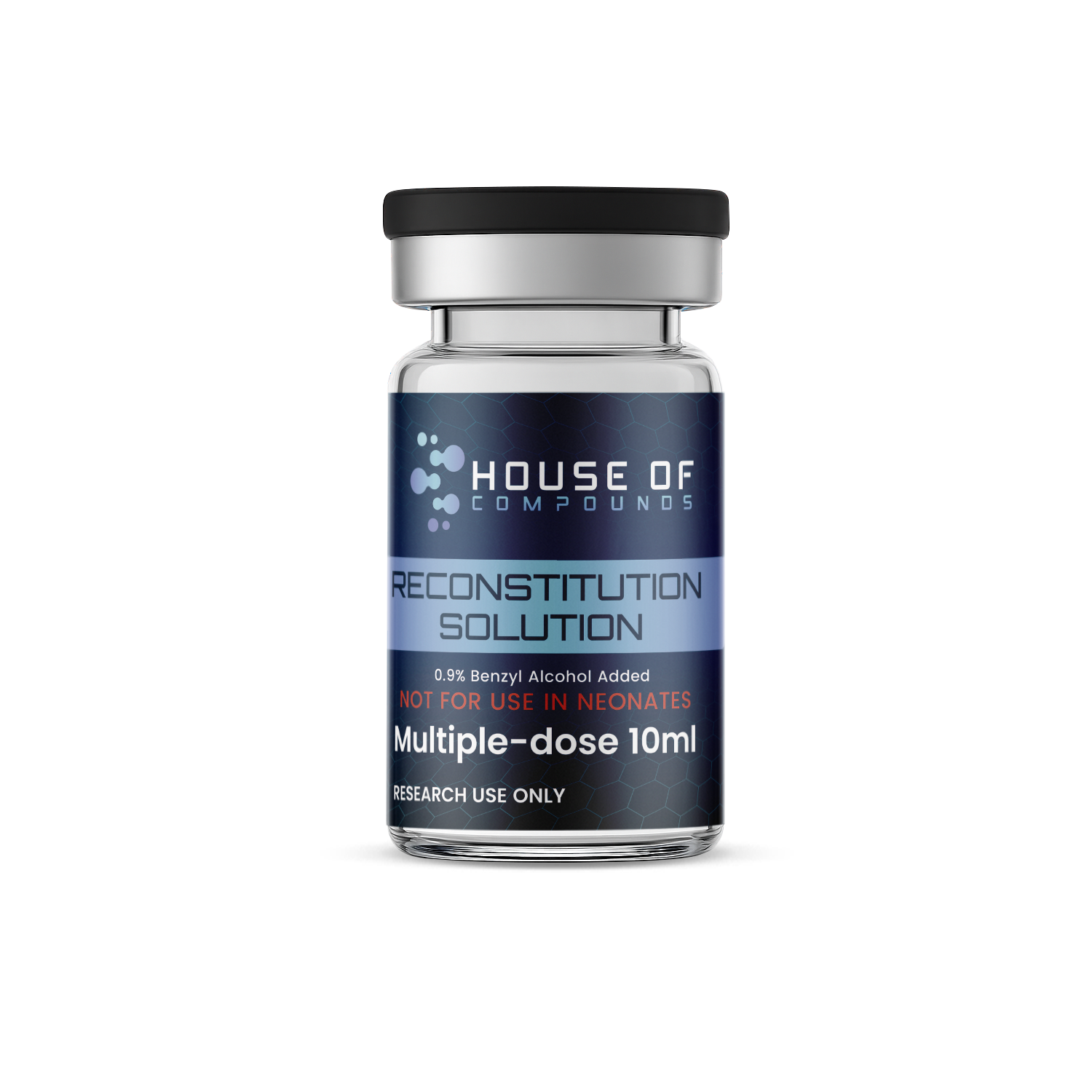
BAC Water
Price range: $19.99 through $29.99
Certificate information is temporarily unavailable.
Additional information
| Weight | 0.0625 lbs |
|---|---|
| Dosage | 10ml, 30ml |
Storage Instructions
All products from House of Compounds are manufactured using a lyophilization (freeze-drying) process. This method is designed to maintain product integrity and allows vials to remain stable during shipping for approximately 3–4 months.
Once a vial is reconstituted with bacteriostatic water, it should be stored in the refrigerator to help maintain stability. Under these conditions, reconstituted material is generally considered stable for up to 30 days.
Lyophilization is a dehydration technique in which compounds are frozen and then exposed to low pressure. This causes the water in the vial to sublimate directly from solid to gas, leaving behind a stable, crystalline white structure. This powder can be kept at room temperature until reconstitution.
Upon receipt, products should be stored away from heat and light. For short-term use, refrigeration at approximately 4°C (39°F) is suitable. For long-term storage (several months to years), vials may be placed in a freezer at approximately -80°C (-112°F). Freezing is the preferred method for preserving product stability over extended periods.
⚠️ Important Notice:
These products are intended for research use only. Not for human consumption.
Related products
-
Sale!
KLOW GHK-Cu / KPV / BPC-157 / TB500
Original price was: $189.99.$149.99Current price is: $149.99. -
Sale!
-
Sale!
Wolverine Blend – BPC-157 (5mg) / TB500 (5mg)
Price range: $84.99 through $129.99Select options This product has multiple variants. The options may be chosen on the product page
Research Use Only
The following peer-reviewed publications reference compounds for laboratory and in vitro research purposes only. Not for human or animal use. Not intended to diagnose, treat, cure, or prevent any disease or condition.
Published Scientific Research
Peer-reviewed laboratory studies investigating research peptides
Membrane Vesicle-Mediated Delivery of Antibacterial Lipopeptides by .
Functional assays showed that BAC-loaded MVs exhibit antibacterial activity against and the marine pathogen , linking vesicle-mediated metabolite delivery to microbial competition.
View Full StudyPeptides: Emerging Candidates for the Prevention and Treatment of Skin Senescence: A Review.
Based on their mechanism of action, they can be classified into signal peptides, carrier peptides, neurotransmitter inhibitor peptides, and enzyme inhibitor peptides. Increasing peptide bioavailability and stability for enhanced delivery to the desired site of action and visible effects have become central points for the latest research due to their promising features.
View Full StudySuperhydrophobic candle soot/PDMS substrate for one-step enrichment and desalting of peptides in MALDI MS analysis.
Using this substrate, angiotensin III (Ang III) in the presence of salt with high concentration (2 M or saturated) can be analyzed, and the peptide sequence coverage of 10 μg/mL myoglobin (MYO) and bovine serum albumin (BSA) digests is enhanced to 51% and 26%, which is 37% and 21% analyzed with the commercial ZipTipC pipette tips.
View Full StudyThe multifaceted roles of the matrikine Pro-Gly-Pro in pulmonary health and disease.
In this article, we describe our current understanding of the pathways that generate, degrade and modify PGP to dictate its bioavailability and stability. Accordingly, we discuss how this pathway is subverted in chronic lung diseases giving rise to persistent inflammation and pathological tissue remodelling.
View Full StudyLinear Peptides in Intracellular Applications.
Interestingly, inside cells, endogenous peptides lacking any chemical modifications to enhance stability escape degradation to the point that they may even modulate intracellular signaling pathways. In addition, many unmodified synthetic peptides designed to interfere with intracellular signaling, following introduction into cells, have the expected activity demonstrating that biologically relevant concentrations can be reached.
View Full StudyMarine teleost ortholog of catalase from rock bream (Oplegnathus fasciatus): molecular perspectives from genomic organization to enzymatic behavior with respect to its potent antioxidant properties.
The anticipated promoter region of RbCat contains several transcription factor-binding sites, including sites that bind with immune- and antioxidant-responsive signaling molecules, suggesting its substantial transcriptional regulation. However, it demonstrated substantial peroxidase activity within a broad range of temperatures and pH values.
View Full Study