
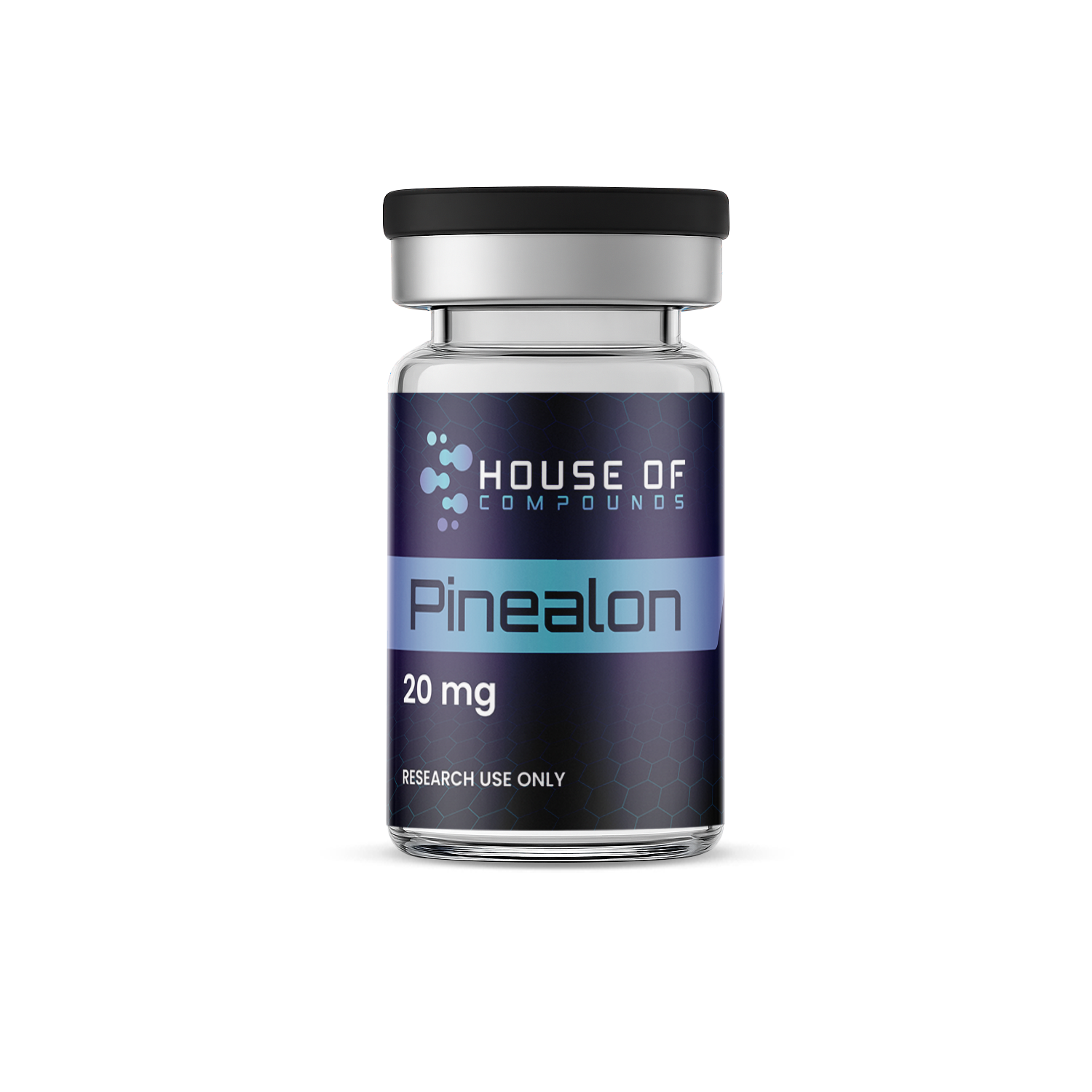
Pinealon (20mg)
Original price was: $99.99.$79.99Current price is: $79.99.
1 published certificate
Certificate information is temporarily unavailable.
Description
A single-component research material supplied for controlled research environments. Pinealon (20 mg) is a synthetic short peptide sequence studied for its potential role in neuroendocrine regulation, cognitive function research, and epigenetic pathway exploration in model systems.Not for human use.
Documentation & Quality Assurance
Each lot is sourced through our verified global supply chain with emphasis on traceability and quality control.These documents are reviewed internally and displayed as they become available. Independent third-party testing is also performed on select lots to confirm identity, purity, and alignment with our internal specifications.
Important Notice
This product is intended for laboratory research use only. It is not intended for human or veterinary use, and must not be used for diagnostic, therapeutic, or clinical purposes.
This material is not a drug, medical device, or dietary supplement, and has not been evaluated by the U.S. Food and Drug Administration.
Quality & Manufacturing
We work directly with the manufacturers. Each supplier is reviewed for reliability, documentation integrity, and transparency in testing.
We require a verified purity of 99% or higher and perform independent third-party spot testing to confirm that select lots meet our internal standards for identity, purity, and composition. Where available, endotoxin testing results are included on Certificates of Analysis to verify laboratory purity; their inclusion is for research quality assessment only and does not imply suitability for human or veterinary use.
All research materials are sealed for integrity and packaged for stability during storage and transport from manufacturing through final delivery.
Additional information
| Weight | 0.0625 lbs |
|---|
Published Scientific Research
Explore the full library of peer-reviewed studies, clinical data, mechanism breakdowns, and molecular specifications for Pinealon (20mg).
All research is sourced from PubMed-indexed journals for informational and educational purposes only. For Research Use Only (RUO). Not for human use.
View Full Research Library →Storage Instructions
All products from House of Compounds are manufactured using a lyophilization (freeze-drying) process. This method is designed to maintain product integrity and allows vials to remain stable during shipping for approximately 3–4 months.
Once a vial is reconstituted with bacteriostatic water, it should be stored in the refrigerator to help maintain stability. Under these conditions, reconstituted material is generally considered stable for up to 30 days.
Lyophilization is a dehydration technique in which compounds are frozen and then exposed to low pressure. This causes the water in the vial to sublimate directly from solid to gas, leaving behind a stable, crystalline white structure. This powder can be kept at room temperature until reconstitution.
Upon receipt, products should be stored away from heat and light. For short-term use, refrigeration at approximately 4°C (39°F) is suitable. For long-term storage (several months to years), vials may be placed in a freezer at approximately -80°C (-112°F). Freezing is the preferred method for preserving product stability over extended periods.
⚠️ Important Notice:
These products are intended for research use only. Not for human consumption.
Related products
-
Sale!
-
Sale!
N-Acetyl Epitalon Amidate (5 mg)
Original price was: $79.99.$59.99Current price is: $59.99. -
Sale!
Epitalon
Price range: $44.99 through $89.99Select options This product has multiple variants. The options may be chosen on the product page
Research Use Only
The following peer-reviewed publications reference compounds for laboratory and in vitro research purposes only. Not for human or animal use. Not intended to diagnose, treat, cure, or prevent any disease or condition.
Published Scientific Research
Peer-reviewed laboratory studies investigating research peptides
Peptides: Emerging Candidates for the Prevention and Treatment of Skin Senescence: A Review.
Based on their mechanism of action, they can be classified into signal peptides, carrier peptides, neurotransmitter inhibitor peptides, and enzyme inhibitor peptides. Increasing peptide bioavailability and stability for enhanced delivery to the desired site of action and visible effects have become central points for the latest research due to their promising features.
View Full StudyBioactive peptides in cosmetic formulations: Review of current in vitro and ex vivo evidence.
Their claimed biological activities include signaling to increase collagen and hyaluronic acid production, modulation of pigmentation, maintenance of a healthy skin microbiome, antioxidant activity and cellular defense, immunomodulation, neurotransmitter inhibition, enzyme activity inhibition and trace mineral carriers.
View Full StudyOptimization of protein hydrolysis conditions and antioxidant activity of tetrapeptide Asp-Arg-Glu-Leu by elevating the Nrf2/Keap1-p38/PI3K-MafK signaling pathway.
Tetrapeptide Asp-Arg-Glu-Leu (DREL) was isolated from Jiuzao protein hydrolysates (JPHs) by alkaline proteinase (AP) and exhibited antioxidant activity in the HepG2 cell model in the previous study. Considering the limitation of in vitro assays, the AAPH-induced oxidative stress Sprague-Dawley (SD) rat model was selected to measure the antioxidant capacity of DREL in vivo.
View Full StudyEDR Peptide: Possible Mechanism of Gene Expression and Protein Synthesis Regulation Involved in the Pathogenesis of Alzheimer's Disease.
The tripeptide promotes the activation of the antioxidant enzyme synthesis in the culture of cerebellum neurons in rats. Thus, the EDR peptide can change the activity of the MAPK/ERK signaling pathway, the synthesis of proapoptotic proteins (caspase-3, p53), proteins of the antioxidant system (SOD2, GPX1), transcription factors PPARA, PPARG, serotonin, calmodulin.
View Full StudyRole of Mono- and Divalent Ions in Peptide Glu-Asp-Arg-DNA Interaction.
The interaction of the regulatory biologically active peptide Glu-Asp-Arg (EDR) with DNA is considered by spectral, NMR, viscosimetry, and molecular dynamics methods. It was shown that EDR can partly penetrate into the major groove of DNA and affect the base atoms, mainly the N7 and O6 of guanine. It was observed that Mg ions can promote DNA-EDR interaction due to their effective screening of the negatively charged phosphate groups of DNA. This action of Mg remains in salted solution as well.
View Full Study[Pinealon and Cortexin influence on behavior and neurochemical processes in 18-month aged rats within hypoxia and hypothermia].
The research of Cortexin and Pinealon within two models of stress, acute hypobaric hypoxia and mild hypothermia, within 18-month aged rats has been held. The peculiarities of peptide preparations' influence on behavior and neurochemical indeces have been identified. Cortexin shows a more pronounced effect on free radical processes and caspase 3 activity in brain than Pinealon. Both preparations forward an accumulation of adrenergic mediator within rats' brains in the model of acute hypobaric hyp
View Full Study